

You own enough clothes. So why does Monday morning still feel like a crisis?
The problem is almost never the wardrobe. It’s the absence of a plan. Fashion sketching fixes that — not because drawing is a magic creative ritual, but because committing an outfit to paper forces decisions that a quick scroll through Pinterest never demands. This guide covers how to actually sketch school outfit ideas from scratch, which styles are worth drawing, and the one mistake that makes most sketching efforts useless.
Why Fashion Sketching Works Better Than a Mood Board
Saving images is passive. You screenshot an outfit, feel a small rush of inspiration, close the app. Three days later it’s buried under 400 other saved posts and you remember nothing specific about what made it work.
Drawing is different. When you sketch an outfit, you make every decision yourself: Is this a crew neck or V-neck? Are the trousers wide-leg or tapered? What color are the shoes relative to the top? Each line forces a micro-choice. That active processing is why sketched outfits stay in your head longer than anything you scroll past.
Fashion designers use sketching at every level of the industry — from fast fashion interns to senior creative directors — not because they’re artistic by nature, but because a sketch is the fastest way to evaluate a concept before committing money or time to it. You can apply the same logic to a school week.
Reference sketching versus design sketching
These are two distinct uses of the same tool. Reference sketching means drawing outfits using clothes you already own, in new combinations you haven’t tried before. Design sketching means drawing outfits you want to build — pieces you’d need to shop for. For school outfit planning, start with reference sketching. It’s faster, it costs nothing, and it forces you to actually look at what’s already in your wardrobe instead of assuming you’ve seen it all before.
How much drawing skill do you actually need
None, realistically. Fashion figure templates — called croquis in the industry — exist so that drawing ability is never the bottleneck. You trace or download a figure, then draw clothes on top. The figure is just a body-shaped hanger. What you put on it is the point. If you can draw a rectangle, you can sketch a pair of trousers. Sleeves are cylinders. Collars are triangles. The shapes are simpler than they look in finished illustrations.
The Tools That Actually Help (And the Ones That Are Overkill)
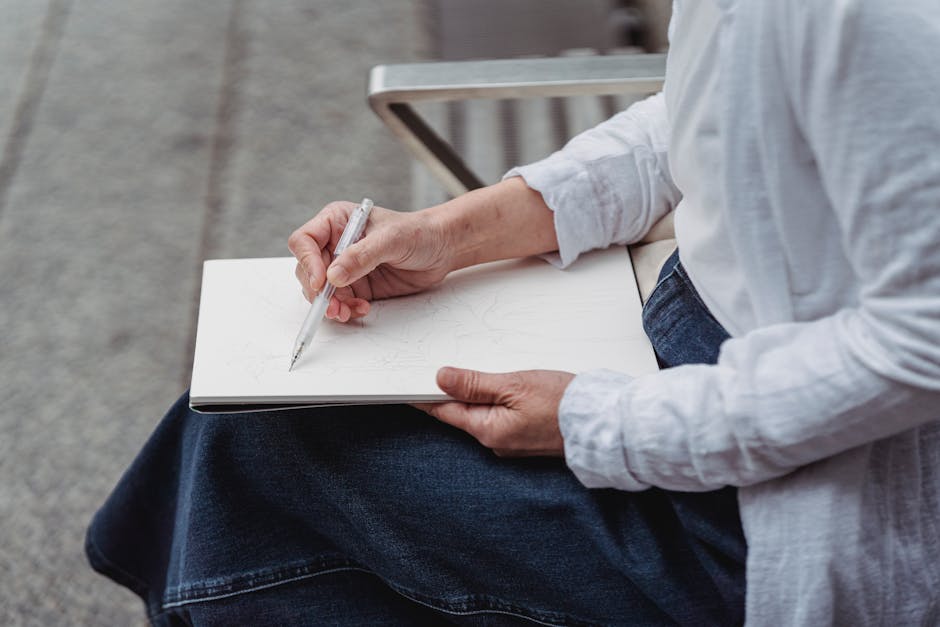
You don’t need a professional kit. But using the right tools makes the process fast enough to sustain as a weekly habit, which is the only way it delivers value.
- Sketchbook: A5 size works well for outfit planning — small enough to carry, large enough for a usable figure. Leuchtturm1917 (120gsm paper) and Moleskine Art Sketchbooks are both reliable. Paper weight matters: under 100gsm bleeds badly with markers and makes the sketches feel disposable.
- Pencils: HB for the initial figure, 2B for outfit contour and drape details. Prismacolor Col-Erase pencils are worth the upgrade — they erase cleanly even after coloring over them, which regular colored pencils do not.
- Color: Copic Sketch markers are the fashion illustration standard, but at $8–12 per marker they’re a significant investment for school outfit planning. Tombow Dual Brush Pens ($2–3 each) give similar blending results and come in sets. For skin tones and fabric base colors, four to six markers is enough to start.
- Digital option: Procreate on iPad with an Apple Pencil. The fashion illustration community on Procreate is large — there are free and paid croquis brush packs on Etsy starting around $3–5. Digital has one major advantage for outfit planning: you can color the same sketch multiple times without redrawing.
- Free option: Print a croquis template from a Google Image search for “9-head fashion croquis,” sketch directly on the printout in ballpoint pen. This costs nothing and works perfectly for planning purposes.
The 9-head croquis explained
Real human proportions are roughly 7.5 heads tall. Fashion figures are drawn at 9 heads — the extra length comes from elongated legs, which makes clothes read more clearly on the page. This is the standard template for fashion sketching. Search for a 9-head front-facing croquis, print it at A5, and use it as a tracing base. After you’ve traced it five or six times, you’ll draw it freehand without thinking.
Analog or digital: which to start with
Analog is faster for rough planning. You sketch, you color, you move on. Digital is better once you want to build a reusable library — sketch the figure once, save it as a layer, then add different outfit layers on top indefinitely without redrawing the body. If you already own an iPad and Apple Pencil, start digital. If not, start with printed templates and a pencil. The output quality is comparable for planning purposes.
6 School Outfit Styles Worth Sketching
Not every outfit style works for school — some are too formal, some fall apart by third period, some require ironing at 6:45am. These six are practical, distinct enough to teach different things about proportion and layering, and wide-ranging enough to cover most school environments.
- Casual classic: High-waist straight jeans (Levi’s 501 is the reference point), a fitted white or navy tee, clean white sneakers. Simple silhouette, easy to sketch, endlessly versatile. This is your anchor outfit — the one every other sketch should be able to swap pieces with.
- Sporty-chic: Tapered jogger pants, an oversized hoodie, chunky trainers like Nike Air Max 90 or New Balance 574. The sketch focus here is the volume contrast: big on top, narrowed at the ankle. Get that proportion right and the look works every time.
- Smart casual: Tailored straight trousers — H&M’s wide-leg tailored trousers run around $35 and photograph well — a half-tucked button-down, and loafers or Oxford shoes. Slightly more elevated. Good for presentations, school photos, or days when you want to look intentional without much effort.
- Layered indie: A long-sleeve thermal under a short-sleeve graphic tee, straight or wide-leg jeans, platform shoes. The key sketch element is showing both layers as visibly separate — the thermal sleeve extending past the tee sleeve. This is a look that’s easy to get wrong in real life when the layers blend together.
- Uniform variation: If your school has a uniform or dress code, sketch variations within the constraint. Different shoe choices, different ways to wear a collar, tights colors, accessories. Working within limits is a stronger design exercise than open-ended sketching. It’s also where sketching delivers the most value — because the options feel limited until you draw them out.
- Art student: Wide-leg trousers, an oversized linen shirt or smock, Dr. Martens 1460 boots or chunky platform loafers. Comfortable enough for a full day, specific enough to read as a personal style. The draped fabric is the hardest element to sketch accurately — but the looseness is part of what makes the look work.
Outfit Styles Compared by What Actually Matters for School

Here’s how the six styles break down across the factors most relevant to school wear:
| Style | Comfort (Full Day) | Dress Code Safe | Best Season | Sketch Difficulty | Shopping Cost to Build |
|---|---|---|---|---|---|
| Casual Classic | High | Yes | All year | Easy | Low — basics are cheap |
| Sporty-Chic | Very High | Usually | Fall / Winter | Easy | Medium — trainers add up |
| Smart Casual | Medium | Yes | Spring / Fall | Medium | Medium — trousers are the investment |
| Layered Indie | High | Usually | Fall / Winter | Medium | Low — thermals and tees are affordable |
| Uniform Variation | Medium | Yes (by design) | All year | Easy | Very low — accessories only |
| Art Student | Very High | Depends on school | Spring / Fall | Hard | Medium-High — quality linen isn’t cheap |
If you’re new to sketching, the Art Student style will frustrate you. Draped, oversized fabric has no clean lines — every fold is a judgment call. Sketch Casual Classic or Sporty-Chic first to build confidence with structure, then move to looser silhouettes.
The Gap Between Sketch and Reality (Most People Get This Wrong)
The most common sketching mistake isn’t a drawing problem. It’s treating your sketchbook as a fantasy board instead of an inventory plan.
You sketch the perfect layered look — oversized neutral blazer, wide-leg trousers, minimal white sneakers. Clean, considered, exactly what you’d want to wear. Then Monday arrives and you don’t own the blazer, the trousers are in the wash, and the sneakers you do own are bright red. The sketch was aspirational fiction, not a plan.
Fix it with one non-negotiable rule: every item in every sketch must be labeled with its real name. Not “white tee” — “H&M ribbed crew-neck tee, second drawer.” Not “trousers” — “navy ZARA straight-leg trousers, hanging in wardrobe.” If you cannot name the specific item you own, the outfit lives in your imagination only. Put a star next to sketched pieces you don’t own yet — those stars become your shopping list.
A second failure mode: sketching outfits in isolation without thinking about resource conflicts. You sketch Monday’s look using your only pair of cream trousers. Then Wednesday’s sketch also needs those trousers. In a real week, one of those outfits breaks down — either you wear the same trousers twice in three days (fine, but you should plan it deliberately) or Wednesday falls apart entirely. Sketch the full week side by side, not one day at a time. Treat your key pieces as shared resources across the rotation.
When a sketch uses something you don’t own yet
This is design sketching, and it’s valuable — but mark it clearly. Color those items differently, or write “to buy” next to them. Now your Sunday sketching session produces a concrete, specific shopping brief: not “I want something that looks more put-together,” but “I need a straight-leg trouser in either navy or stone, not wide-leg, not cropped.” That’s a useful prompt when you’re browsing ASOS or walking through an H&M. Generic inspiration has no actionable output. A labeled sketch does.
Proportion mismatch between sketch and real life
Fashion croquis are drawn at unrealistic proportions — deliberately elongated, editorial. When you sketch an outfit on a 9-head figure and then try to replicate it on your own body, the proportions feel off. The hem sits differently. The top looks longer or shorter than expected. For planning purposes, adjust the figure’s proportions to roughly match yours. A shorter torso, a different leg-to-body ratio, whatever reflects reality. An accurate-looking sketch built on a model’s proportions is actively misleading when your body reads the look differently.
Turning Sketches Into a Weekly Outfit Rotation
How many outfits should you sketch per week?
Five minimum — one per school day, plus a sixth if you have PE or a sport that requires a separate kit. The goal isn’t rigid adherence to the plan. It’s eliminating morning decision fatigue entirely. When you’ve already decided what you’re wearing on Sunday, Monday morning becomes a five-minute operation instead of a twenty-minute spiral. Having a backup for each day (sketched as a small secondary figure on the same page) adds resilience if something is dirty or the weather shifts.
Should the same pieces appear across multiple days?
Yes — deliberately and visibly. Sketch Monday with your Levi’s 501s in one combination. Sketch Thursday with the same jeans, different top, different shoes. Seeing both sketches side by side confirms the jeans carry two genuinely different looks and aren’t just being repeated lazily. This is how capsule wardrobe thinking works in practice: a well-chosen piece appears multiple times per week and reads differently each time. Sketching makes this intentional rather than accidental.
How to handle seasonal transitions in your sketchbook
The fall-to-winter and winter-to-spring windows are the hardest weeks to dress for — temperature swings of 10–15 degrees between morning and afternoon are common. Sketch transition outfits that show the base look plus one removable layer: a cardigan, a Uniqlo Ultra Light Down jacket, a denim overshirt. Draw the layered version and the de-layered version on the same figure so you can see both states. Uniqlo’s Heattech base layers and their Light Down jackets (around $80–100) are worth planning specifically into fall sketches — they add warmth without the bulk that ruins cleaner silhouettes.
Start With This One Sketch
Draw your casual classic. Your most-worn jeans, your everyday tee, your go-to shoes. Label every item with its real name. That’s your first sketch — not something ambitious, not something you’ve never worn.
Once it’s done, draw a second version on the same page: same jeans, different top, different shoes. That comparison is where outfit sketching starts delivering. You’ve just created two distinct looks from three shared pieces — and you did it in ten minutes before Monday morning could force the decision for you.