The verdict upfront: grunge kitsch works when it reads as a consistent point of view, not a costume. Pull it off, and you look intentional, layered, and genuinely cool. Get it wrong, and you look like you raided two different theme parties and couldn’t decide which one to attend. Here’s the distinction between those two outcomes.
What Grunge Kitsch Actually Is — and the Aesthetic History Behind It
Grunge and kitsch occupy opposite poles, and yet their collision is more natural than it first appears.
Grunge, in its original form, emerged from Seattle in the late 1980s. Flannel shirts worn thin at the elbows. Ripped jeans. Heavy work boots. A muted palette of charcoal, olive, and burgundy. The aesthetic came from working-class anti-fashion — wearing what was affordable and functional, deliberately rejecting the glossy excess of 1980s pop culture. Kurt Cobain famously wore a $1 thrift store cardigan to the MTV Unplugged taping. That was the point.
Kitsch is its philosophical opposite. Excess, irony, the so-bad-it’s-good. A ceramic flamingo. A lunchbox printed with cartoon skeletons. Rhinestone brooches shaped like insects. The kind of objects that pile up in your grandmother’s curio cabinet, now reclaimed with post-modern affection. Kitsch doesn’t take itself seriously — that’s its entire value proposition.
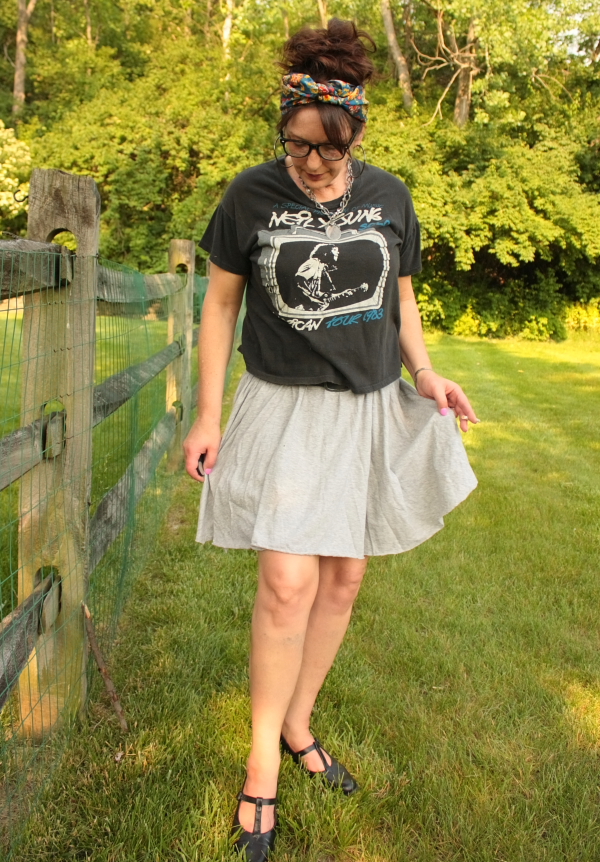
Grunge kitsch fuses both: the dark palette and rebellious texture of grunge with the playful, slightly absurd sensibility of kitsch. A velvet babydoll dress printed with cherries, worn with fishnet tights and Doc Martens. A vintage horror tee tucked into a tiered plaid skirt, cinched with a studded belt, accessorized with a resin alien pendant. The outfits feel simultaneously confrontational and charming.
This fusion has genuine fashion history behind it. Vivienne Westwood was arguably doing grunge kitsch before anyone had a name for it — taking punk’s raw edges and layering in tartan plaids, faux pearls, and pirate-camp theatrics throughout the 1980s. Anna Sui’s 1990s collections dressed the underground rock scene in dark florals and whimsical grunge; her runway work from 1993 through 1997 is the clearest historical reference point for the aesthetic as it exists today.
The critical distinction from adjacent aesthetics matters. Dark academia is literary and structured — blazers, oxford shoes, warm tones. Nu-goth runs minimalist and sleek: clean black, silver hardware, no whimsy. Soft grunge sands down the roughness for an Instagram-palatable result. Grunge kitsch specifically keeps the roughness AND layers in playful elements that feel almost deliberately out of place — and that tension is the whole mechanism.
Fashion critics have generally found that the aesthetic collapses when either element overtakes the other. Too much kitsch, and the dark grounding disappears — you end up with novelty clothing. Too much grunge, and the playful layer vanishes — you’re just doing goth. The balance is specific, which is what makes it difficult to execute and interesting to look at when done well.
The 8 Core Wardrobe Pieces That Make This Aesthetic Work
- Dr. Martens 1460 Boots (~$170) — Eight-eyelet, yellow stitching, air-cushioned sole. The foundational footwear. Not interchangeable with Chelsea boots, combat boots, or anything sleeker. The chunkiness is structurally necessary; it anchors the darker half of the aesthetic against whatever kitsch elements appear above it.
- Babydoll or Slip Dress in a Dark Print — Black velvet, deep burgundy floral, or dark plaid. Anna Sui’s 1994–1996 archive is the best reference for what this looks like at its best. Thrifted 1990s versions typically outperform fast fashion reproductions at any price point — the fabric weight is different, and it shows.
A practical note here: when building this wardrobe, prioritize footwear first. It’s the most load-bearing aesthetic decision in the entire outfit. The wrong shoe undercuts every other piece; the right shoe does real work for you even when the rest of the look is simple.
- Shrunken Graphic Tee with Cartoon or Horror Imagery — Not a standard band tee (different aesthetic lane). A cartoon skull, a vintage horror movie still, or deliberately nostalgic iron-on imagery. Cropped versions work well layered under slip dresses or open flannel shirts.
- Fishnet Tights or Layered Hosiery — Worn under shorts, under torn hems, or doubled under opaque tights for texture contrast. Wolford makes excellent fishnets at $40+ if durability matters. Generic drugstore fishnets at $8 also work and, frankly, tear with a certain dignity that suits the aesthetic.
- Demonia Camel-311 Platforms (~$90) — Or any chunky platform that reads 90s club kid rather than current minimalist trend. Demonia’s catalog is the most credible mid-range reference point for this specific footwear category.
General sourcing rule: thrift the accessories, outerwear, and graphic tees. Buy footwear and base layers new when condition and fit matter. Thrifted basics come with sizing unpredictability that works against you; thrifted accessories and statement pieces carry exactly the kind of provenance the aesthetic benefits from.
- Oversized Flannel or Thrifted Blazer — Worn open over a slip dress, loosely tied at the waist, or layered over a graphic tee. Goodwill, Depop, and ThredUp are the most consistent sources. New flannel almost universally looks too clean and stiff to function here.
- Statement Accessories That Feel Slightly Wrong — This is where kitsch enters most directly. A lunchbox worn as a bag. A rhinestone frog brooch pinned to a leather jacket. An enamel alien pin next to a vintage concert button. These items should feel like they came from five different places — because they should. The wrongness is the mechanism, not the mistake.
- Chunky Silver Jewelry and Layered Chains — Not delicate gold. Chunky, slightly tarnished-looking hardware, mix-matched deliberately. A hardware-store chain layered with a resin pendant shaped like a planet or a coffin works better than anything sold as a “set.” Claire’s, flea markets, and Etsy vintage sellers are all valid sources.
The ratio to keep in mind: kitsch elements should read as deliberate additions to a grunge foundation, not as the foundation itself. If someone looking at the outfit can’t identify the base aesthetic, you’ve tipped too far into novelty territory.
How to Style Grunge Kitsch Without It Reading as a Costume
Can grunge kitsch work for daytime?
Yes, with adjustment. The most common mistake is treating it as a night-out aesthetic by default. A babydoll dress, chunky boots, and a cardigan with embroidered cats reads as grunge kitsch at noon in a coffee shop. The key is keeping the silhouette wearable — not too much volume, not too many statement pieces competing at once. Daytime grunge kitsch typically runs one major graphic or statement item per outfit, with the remaining pieces in a supporting role.
How many kitsch items can one outfit carry?
Typically, three is the ceiling. One statement accessory, one novelty print or embellishment on a garment, and one unexpected layering choice — the wrong-era brooch on the leather jacket, or the alien enamel pin on the flannel. Beyond three, the outfit starts reading as overwhelm rather than personality. Fashion critics have generally found that the most credible grunge kitsch outfits are anchored by at least one completely unironic foundational piece. Something that isn’t trying to be anything. That anchor is what lets the playful elements read as intentional.
Does thrifting actually outperform fast fashion for this aesthetic?
In most cases, yes — and the reason is texture. Fast fashion versions of grunge kitsch pieces look clean and synthetic in a way that undercuts the visual tension the aesthetic depends on. A real 1990s band tee has fading, cracking, and fabric weight that no current mass-market version replicates. The exception is basics: fishnet tights, plain dark garments, and platform shoes, where new versions are typically equivalent to or better than thrifted, because condition and fit matter more than provenance there.
Brands Actually Doing Grunge Kitsch Right
Not every brand that markets itself as alternative is executing grunge kitsch credibly. Here’s where the legitimate options actually sit, with honest notes on where each one falls short.
| Brand | Price Range | What They Do Well | Watch Out For |
|---|---|---|---|
| Lazy Oaf | $50–$200 | Dark prints with cartoon and whimsical elements; strong kitsch sensibility without losing the grunge edge | Some pieces lean too cute and lose the dark grounding entirely |
| Killstar | $40–$150 | Gothic-kitsch crossover; occult imagery with velvet and mesh layering | Quality control is inconsistent — read reviews carefully before ordering |
| Unif | $60–$250 | LA-based 90s influence with a harder edge; strong footwear and outerwear selection | Sizing runs small; limited runs sell fast |
| Iron Fist | $30–$120 | Horror-kitsch aesthetic in footwear and accessories; affordably weird | Some collections tip into costume territory — curate with care |
| Anna Sui | $150–$600+ | The designer-level reference point; dark florals and vintage grunge refinement | Investment pricing; not suitable for casual aesthetic exploration |
| Vivienne Westwood | $200–$1,500+ | The origin point; punk-kitsch-tailoring fusion with genuine historical weight | Out of range for most buyers; valuable as a reference, not a shopping destination |
For most people building this aesthetic on a practical budget, Lazy Oaf is the most consistently reliable starting point. Their pieces are credibly kitsch without tipping into novelty, and their dark colorways keep the grunge tension alive. Unif is the better call if you want the look to skew edgier and the budget supports it.
The Real Reason Most Grunge Kitsch Attempts Fall Flat
Costume thinking. The outfit gets assembled as a collection of aesthetic signals — this is dark, this is quirky, this is 90s — rather than as a coherent personal expression. Grunge kitsch isn’t a checklist. It’s a sensibility, and a person wearing it with genuine conviction looks entirely different from a person wearing the same items as a reference.
When Grunge Kitsch Is the Wrong Aesthetic for Your Wardrobe
If your natural instinct is to remove one more thing before leaving the house, grunge kitsch will probably fight you rather than work for you. That’s not a failure — it’s an honest aesthetic incompatibility.
The look requires tolerance for visual density. Layering, texture contrast, the deliberate wrong-note accessory — these mechanisms are non-negotiable. A minimalist who attempts grunge kitsch typically strips out the elements that actually make it function, ending up with a dark outfit that reads as nothing in particular.
If your style leans minimalist, dark academia is a more compatible direction. It shares the dark palette and the intellectual edge without requiring the kitsch layer. Brands like Toteme, COS, and & Other Stories offer dark-toned pieces with enough texture to satisfy whatever impulse drew you toward grunge kitsch — but without the visual density requirement.
For wardrobes that need to cross regularly into professional or semi-professional contexts, grunge kitsch doesn’t adapt easily. The aesthetic is fundamentally anti-institutional — that’s historically embedded, not a styling oversight — and attempts to tone it down for office wear typically produce something that reads as neither grunge kitsch nor professional. In that situation, nu-goth, which runs sleeker and more structured, is a more flexible foundation to build from.
Grunge kitsch works best for people who already have a relationship with secondhand shopping, who aren’t bothered by looking slightly off-kilter in public, and who find the dark-playful tension genuinely energizing to maintain. If that description fits, the aesthetic has real staying power. If it doesn’t, the comparison below points to better-suited alternatives.
Grunge Kitsch vs. Similar Aesthetics: Quick Reference
Where grunge kitsch sits relative to the aesthetics it’s most often confused with:
| Aesthetic | Mood | Key Pieces | Tone | Best Fit |
|---|---|---|---|---|
| Grunge Kitsch | Dark + playful, deliberately tense | Babydoll dress, chunky boots, novelty accessories, fishnets | Anti-establishment but charming | Tolerates visual density; enjoys irony in dressing |
| Soft Grunge | Nostalgic, gently dark | Floral grunge tees, worn denim, pastel accents | Tumblr-era palatability | Grunge-adjacent, lower visual intensity |
| Nu-Goth | Sleek, modern, monochrome | Minimal black, geometric cuts, silver hardware | Cold, intentional, structured | Minimalists who want darkness without whimsy |
| Dark Academia | Intellectual, literary, warm-dark | Blazers, plaid, turtlenecks, oxford shoes | Studious and composed | Wants dark aesthetic with structure and professional crossover |
| Cottagecore Dark | Whimsical, nature-based, moody | Prairie dresses, mushroom prints, earth tones | Romantic and melancholic | Kitsch-curious without the punk edge |
This is not legal advice — consult a licensed attorney for any legal questions relating to fashion industry intellectual property, trademark matters, or counterfeit goods concerns.